WoGF Book Review: Sword of Fire and Sea by Erin Hoffman

This is my seventh book review for the Women of Genre Fiction Reading Challenge at Worlds Without End.
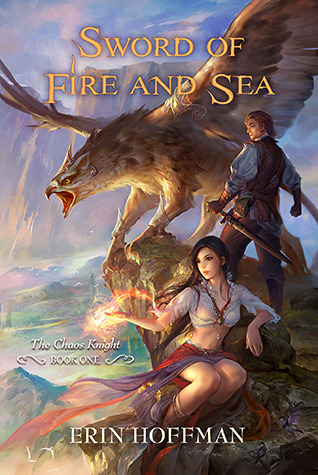
Sword of Fire and Sea by Erin HoffmanSword of Fire and Sea by Erin Hoffman was a light, fun book.  By no means perfect, but quite enjoyable.

Captain Vidarian Rulorat is commissioned by the fire priestesshood to transport one of their own to a place of safety, beyond the reach of the Vkortha who are hunting her.  Thus, he sets himself a course that will change his life and change the world.

The magic system is one of elements—earth, air, water, and fire—the source of which are the four goddesses.  Most magic users are women, priestesses, and can wield only one element, but during the course of saving the fire priestess Ariadel’s life, Vidarian finds himself suddenly in possession of both fire and water magic, and the subject of prophecy.  The magic is never described in much detail, but I enjoyed seeing Vidarian stumble through discovering his own, rather than having a teacher on hand to give him all the answers.

The griffins were wonderful.  Sentient, telepathic, magical creatures, and fresher than the standard dragons.  It was nice to see their limitations, too; if they wanted to fly with humans, the griffins had to work together in twos or three to carry them in air gondolas.  I also appreciated that they were characters in their own right, not just talking extensions of their masters’ will.

The gender balance of the cast was great.  I think it actually skewed toward more females than males, because the priestesses were of course all women, but it’s always nice to see a fantasy culture where women are actually considered equal.  The crew of Vidarian’s ship seemed to be a pretty even split, and the other sea captain we meet is female—and to the characters, it was nothing remarkable.

I was a bit disappointed by the love interest.  She started out great, saving the whole ship from a pirate attack, but then it seemed like as soon as she became the love interest in earnest, all she did was get rescued and get jealous of Vidarian’s former fiancée.  And speaking of love, physical attraction is one thing, but Vidarian started calling her the woman he loves entirely too quickly for me to believe it.

I don’t want to spoil the ending, but I love that the quest started out as a very black and white goal, and morphed into an actual choice.  I’m not sure I like the love interest’s role in the choice, and I’m not sure I agree with Vidarian’s ultimate reasoning behind his choice, but I was glad he had to make it, and that it had real, immediate consequences.

I didn’t love Sword of Fire and Sea so much I’ll rush to read the next book, but it is going on my list.

WoGF Book Review: The Queen of Attolia by Megan Whalen Turner

This is my sixth book review for the Women of Genre Fiction Reading Challenge at Worlds Without End.

The Queen of AttoliaThe problem with trying to write a review of The Thief is that the only thing really worth dissecting is the twist ending, which of course I can’t do without spoiling the whole book.

I thought I was going to have the same problem with The Queen of Attolia, that anything I say about it would spoil the first book, but happily that doesn’t seem to be the case.  So I’m going to cheat a little on the challenge, and review the second book I’ve read by Megan Whalen Turner.

I went into this knowing that the second book was supposed to be much better than the first, but that there’s a really big twist at the end that makes the first book worth reading.  I haven’t decided yet whether knowing about The Thief‘s twist made for better reading or not—it certainly made it much easier to guess, but probably lessened the feeling of betrayal on finding out the first person narrator has been concealing things for the whole book.  But I wholeheartedly agree that the second book is better, and I actually found it to be more surprising than the first.

One thing The Queen of Attolia does that I don’t see often is show believable consequences to trauma.  It actually made the book start out rather slow, because after something terrible happens to Eugenides in the opening, he basically spends the first quarter of the book recovering (read: not doing anything).  I was actually beginning to wonder if the book had been over-praised.  Eventually Gen is knocked out of his funk and the story takes off, but the trauma stays with him. He doesn’t just bounce back unchanged, and I end up feeling so much more connected to him as a character because of it.

The other thing I absolutely loved about this book was the complex characterization of the villain.  The queen of Attolia does horrible things to Gen, and we hate her for it, but we slowly come to understand why she is so ruthless, and that her actions didn’t only hurt Gen.

The surprises in this book were so organic, I don’t think I would even call them twists.  Now that Eugenides’s character is firmly established from the first book and a half, it doesn’t feel like a cheat that he would keep his plans to himself, and the contents of those plans–well.  I thought they were perfect.  As events unfolded in their fullness, I had fun watching the subtext of the key players’ words and actions, and feeling like I was in on the secret.  I imagine some less attentive readers, or possibly the middle grade audience it was written for, might not catch the subtler clues, and therefore get a dramatic twist ending, but I didn’t feel like my reading experience was in any way diminished by guessing the ending ahead of time.

Oh, and I can’t close the review without at least mentioning the setting, which is an alternate Greece.  Totally different from the usual medieval European fantasy setting, and I love the way the gods are woven in and made an integral part of the story.

My verdict: The Queen of Attolia by Megan Whalen Turner is absolutely worth reading, and while I wouldn’t recommend The Thief on its own, I believe that reading it first enhanced my reading of The Queen of Attolia.  So, go out and read both of them.  And then read the next book, too, because I think that might be the best of them all.